
iFixBasements offers a waterproof, wood-look plank floor built for the one place wood floors fail: a basement. Raised pegs underneath hold it off the cold, damp slab so it breathes, and if there’s ever a leak, the planks lift out, dry, and go back down.
I personally inspect and design the fix; a licensed & insured certified dealer crew installs it. The estimate is free, and no-money-down financing is available.
This is part of Phase 2 — “halfway to finished” — in my three-phase approach to basement finishing. See all three phases.
If you’ve ever stood on a basement floor in January, you know why most people leave it bare. And if you’ve ever seen what a wet spring does to a wood or laminate floor on a slab, you know why they should. A finished basement is only as good as what’s under your feet.
Why real wood and most laminates don’t belong on a basement slab
A concrete slab is never fully dry. It gives off moisture vapor all year, and wood and laminate soak that up. The result is swelling, cupping, a musty smell, and eventually mold underneath where you can’t see it. Add one plumbing leak, a failed sump pump, or a flooded spring, and the whole floor is a tear-out. The fix isn’t a better finish. It’s a different kind of floor.
How this floor is built
- No wood, no organic material. There’s nothing in the plank for mold to feed on, and nothing to rot or buckle.
- Modular planks that lock together. The floor goes down as one connected surface without gluing it to the slab.
- Raised pegs underneath. They hold the floor off the cold, damp concrete so air can move beneath it. Vapor isn’t trapped, which takes away a common cause of basement odors and mold.
- A thermal break. The surface stays up to 10 degrees warmer than bare concrete.
- Lift, dry, and put back. If there’s ever a leak, the planks come up, everything dries, and the same planks go back down. No replacement.
See it in action

Questions about your basement floor?
The video shows the classic plank colors. The new wide plank line is just below.
New wide plank colors
The newest line is a wide plank, about 7.5 inches wide by 48.5 inches long, in four wood-look colors. The same raised pegs on the underside hold it off the slab, so the floor breathes and lifts out to dry if there’s ever a leak.
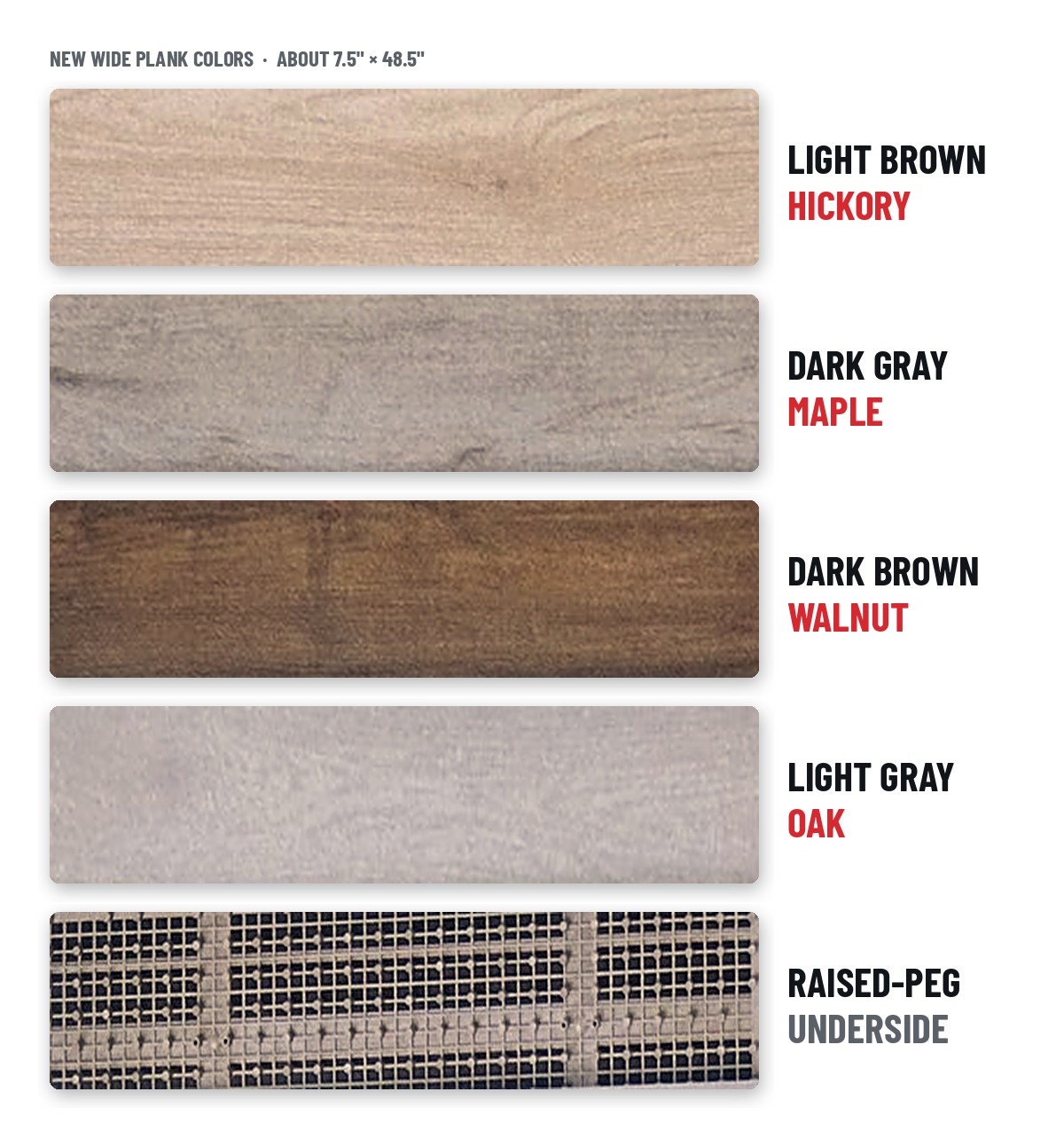
- Light brown hickory: a warm, light, natural wood tone.
- Dark gray maple: a muted gray with visible grain.
- Dark brown walnut: a rich, dark brown.
- Light gray oak: a pale, cool gray.
Classic plank colors, still available for a limited time
The original classic plank, in light pecan, dark walnut, espresso, and gray, is still available for a limited time. If one of those is the look you want, say so at the estimate.
Colors look different in a basement than they do under a showroom light, so we’ll talk through which finish suits your space at the estimate.
Fix the water first, then finish the floor
A floor that handles damp conditions is not the same thing as stopping water that’s coming in. If your basement leaks, the order matters: handle the water first with the right basement waterproofing system, then finish the floor on top of a dry foundation. If the basement is already dry, I’ll tell you that too, and we can go straight to the floor. And if you’re thinking about a new outside way into the basement, see our basement entrance doors and stairs.
How I handle it
- I look at the slab and the room. Moisture, cracks, floor drains, and the layout all matter to how the floor goes down.
- I design the plan. Plank style, layout, and anything that has to be handled before the floor goes in.
- A dealer crew installs it. I personally inspect and design the fix, then a licensed & insured certified dealer crew installs it.
My name and my reputation are on every job, so I’m not walking away after a proposal; I’m involved in making sure it’s done right.
Why homeowners call me
I’ve been doing this long enough to have over 100 five-star Google reviews from people in exactly this situation, and I share a lot of real basement footage — the good, the bad, and the genuinely gross — with about 10,000 followers on Instagram (@ifixbasements) so you can see what these spaces actually look like, not just stock photos.
Where I work
I estimate jobs throughout New York — all five NYC boroughs, Long Island (Nassau and Suffolk), Westchester, Putnam, Rockland, Orange, Ulster, Dutchess, Sullivan, Greene, and Columbia Counties — plus northern and central New Jersey (down through Mercer and Monmouth Counties) and Wayne and Pike Counties in Pennsylvania. See the service-area map →
Straight Answers
Frequently asked questions
Can I put real wood or laminate flooring in a basement?
It’s risky. A concrete slab holds and releases moisture all year, and wood or most laminates soak it up, swell, and can grow mold. One plumbing leak or a wet spring can ruin the whole floor. That’s why I recommend a floor with no wood or organic material in it.
What makes this flooring different?
The planks lock together as a modular floor, and the underside has raised pegs that hold it off the concrete. Air can move under it, so vapor isn’t trapped against the slab, and the thermal break keeps the surface up to 10 degrees warmer than bare concrete.
What happens if the basement ever gets wet?
The planks lift out, the slab and the underside dry, and the planks go back down. There’s nothing to rip out and replace, which is the point of building a basement floor this way.
What styles and colors are there?
The newest line is a wide plank, about 7.5 inches by 48.5 inches, in light brown hickory, dark gray maple, dark brown walnut, and light gray oak. The original classic plank, in light pecan, dark walnut, espresso, and gray, is still available for a limited time. We’ll go over which finish suits your space at the estimate.
Should I fix a wet basement before I put down a floor?
Yes. A floor that handles damp conditions is not a substitute for stopping water that’s actively coming in. If there’s a leak, I’ll tell you plainly and we’d take care of the water first, then finish the floor.
What drives the cost of a basement flooring project?
The square footage, the shape of the room, the condition of the slab, and the plank style you choose. I don’t quote a number until I’ve seen the space in person; the estimate is free, and no-money-down financing is available.
Who installs it?
I personally inspect and design the fix, then a licensed & insured certified dealer crew installs it.